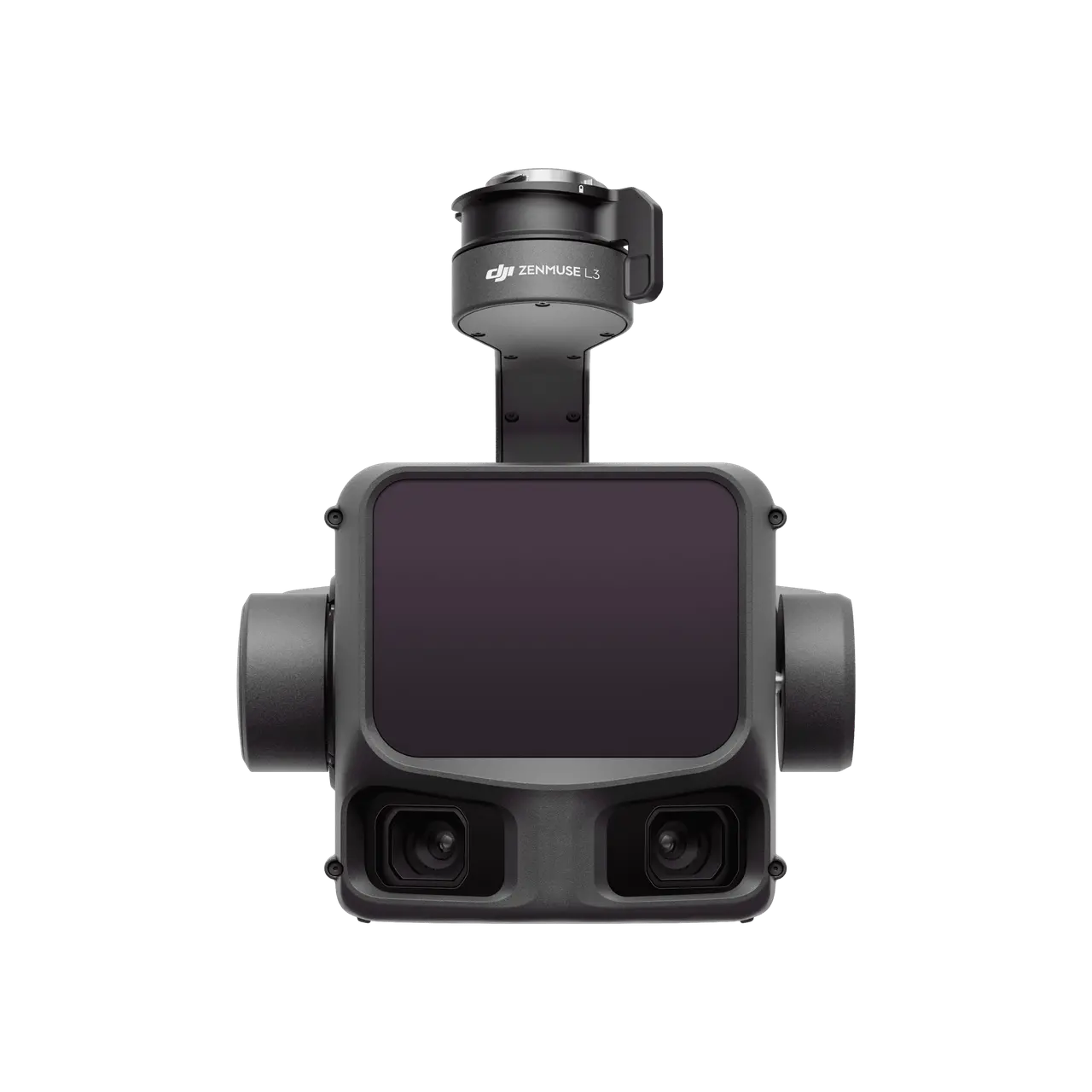
Zenmuse L3 Worry-Free Plus Combo
Select Combo
Take a Closer Look
1535nm Long-Range LiDAR
Zenmuse L3 achieves a maximum detection range of 950 m [1] at a pulse rate of 100 kHz, tested under 100 klx ambient light and on objects with 10% reflectivity.

Dual 100MP RGB Mapping Camera System
Equipped with dual 100MP 4/3 CMOS RGB sensors and a mechanical shutter, Zenmuse L3 delivers significantly enhanced accuracy and efficiency. Pixel binning supports an effective 25MP resolution.

High Accuracy
Vertical accuracy is better than 3 cm at 120m altitude, better than 5 cm at 300 m, and better than 10 cm at 500 m [3], easily supporting mapping projects at 1:500, 1:1000, and 1:2000 scales.

High Penetration
Provides superior penetration capability with a smaller laser spot and higher single-pulse energy. For terrain mapping and similar uses, L3 captures more complete ground points for better results.

High Efficiency
When mounted on DJI Matrice 400, Zenmuse L3 delivers outstanding efficiency. At a flight altitude of 300 m, a single flight can cover up to 10 km², enabling up to 100 km² of daily coverage [2].

End-To-End Solution
Zenmuse L3 integrates with DJI's ecosystem to deliver an end-to-end mapping solution. Enjoy simpler, unified workflows from data acquisition and processing to application.
In the Box

Zenmuse L3
× 1

Zenmuse L3 Lens Cap
× 1

CFexpress™ Type B Memory Card (1 TB) (brand may vary; actual product received prevails)
× 2

CFexpress™ Type B Card Reader
× 1

Zenmuse L3 Storage Case
× 1

Lens Cleaning Cloth
× 1

DJI Matrice 400 Carrying Case Insert (Zenmuse L3)
× 1

Zenmuse L3 Single Gimbal Connector
× 1

Screws and Tools
× 1

Zenmuse L3 Gimbal Damper (4 pcs)
× 1
Let’s Answer Your Questions
What aircraft is Zenmuse L3 compatible with? Which gimbal interface can it be mounted on?
Compatible with DJI Matrice 400, and requires the use of the Zenmuse L3 single gimbal connector. Please ensure that the gimbal connector is connected to the E1 port on the aircraft's underside. Otherwise mapping accuracy will be reduced.
How does the range of Zenmuse L3 change at different laser pulse emission frequencies?
290 m (center), 200 m (edge)@10% reflectivity, 2000 kHz, recommended operating altitude ≤ 50 m
400 m (center), 280 m (edge)@10% reflectivity, 1000 kHz, recommended operating altitude ≤ 100 m
700 m (center), 500 m (edge)@10% reflectivity, 350 kHz, recommended operating altitude ≤ 300 m
950 m (center), 650 m (edge)@10% reflectivity, 100 kHz, recommended operating altitude ≤ 500 m
1. Range Definition: The range is defined as the distance at which 50% of the emitted laser pulses are detected. If a laser beam hits more than one subject, the total laser transmitter power is split and the achievable range is reduced.
2. Test Conditions: 100 klx ambient light, within the central area of the FOV, using a flat subject with a size larger than the laser beam diameter, a perpendicular angle of incidence, and an atmospheric visibility of 23 km.
3. The maximum detection range is 900 m by default. For a longer range, contact DJI support or an authorized dealer.
What improvements does Zenmuse L3 have compared to the previous generation?
Hardware performance improvements:
1. Zenmuse L3 delivers enhanced LiDAR performance. When measured at the same distance, Zenmuse L3 produces a laser spot about one-fifth the size of L2 and supports up to 16 returns. This means much stronger penetration capability, greater range, and higher ranging accuracy.
2. The new dual 100MP RGB mapping camera system brings a horizontal FOV of up to 107°, compared to L2's 73.7°.
3. POS accuracy is improved to 0.02° for heading, and 0.01° for roll and pitch.
Accuracy and efficiency improvements:
1. Zenmuse L3's vertical accuracy is better than 3 cm at 120m altitude, better than 5 cm at 300 m, and better than 10 cm at 500 m. The point cloud thickness produced by Zenmuse L3 is only half that of Zenmuse L2, supporting advanced analysis and high-accuracy applications.
2. With a smaller laser spot and higher single-pulse energy, Zenmuse L3 offers superior penetration capability. In terrain mapping and similar applications, it captures more ground points with greater completeness, significantly improving the accuracy and integrity of terrain data for precise surface fitting and reconstruction.
3. When mounted on DJI Matrice 400, Zenmuse L3 delivers outstanding efficiency. At a flight altitude of 300 m, a single flight can cover up to 10 km², enabling up to 100 km² of daily coverage.
What is the dual 100MP RGB mapping camera system for?
The dual RGB mapping camera system expands the horizontal FOV to 107°, enabling each acquisition to cover a broader area. Even with a 20% LiDAR side overlap ratio, you can capture data for both digital orthophoto maps (DOM) and digital elevation models (DEM) in a single flight, thereby greatly improving operational efficiency.
What type of CFexpress™ memory card does Zenmuse L3 require? What if I use a non-bundled card?
It is recommended to use the CFexpress™ Type B memory card (1 TB) that comes with Zenmuse L3. This card is specifically optimized for the unique storage requirements of L3's point cloud data, images, and calibration files, ensuring ideal write speed, power efficiency, and file management.
Using a non-bundled CFexpress™ card may result in lower write speed or less efficient power management, which could lead to frame drops during operational file storage, thus affecting the accuracy of the results. When a non-bundled card is inserted, the app will display a warning message.
How efficient is the surveying and mapping operation of Zenmuse L3? How is it calculated?
Zenmuse L3 can collect data covering an area of up to 10 km² in a single flight, enabling up to 100 km² of mapping per day.
When paired with DJI Matrice 400, Zenmuse L3 can achieve a daily mapping coverage of up to 100 km² (flat terrain, 300m nadir flight altitude, 20% side overlap, 17m/s flight speed, and a total effective flight time of 6 hours).
What is the typical flight altitude for Zenmuse L3? What is the corresponding accuracy?
At 120m Flight Altitude:<br>Vertical Accuracy: 3 cm (RMSE)
Horizontal Accuracy: 4 cm (RMSE)
At 150m Flight Altitude:
Vertical Accuracy: 3.5 cm (RMSE)
Horizontal Accuracy: 5 cm (RMSE)
At 300m Flight Altitude:
Vertical Accuracy 5 cm(RMSE)
Horizontal Accuracy: 7.5 cm (RMSE)
Measured under the following conditions in a DJI laboratory environment:
1. The field contained objects with obvious angular features. DJI Matrice 400 was linked to a position-calibrated D-RTK 3 Multifunctional Station. The flight route was planned using DJI Pilot 2's Area Route (with Calibrate IMU enabled) with Linear scanning. The flight speed was set to 15 m/s, gimbal pitch to -90°, and each straight segment of the flight route was less than 3300 m.
2. Using exposed hard ground checkpoints that conformed to the diffuse reflection model.
3. DJI Terra was used for post-processing with Optimize Point Cloud Accuracy enabled.
Does Zenmuse L3's real-time point cloud data support cloud sharing?
Yes. After the operation, you can select real-time point cloud results in DJI Pilot 2 and upload them to the relevant project in DJI FlightHub 2 for emergency decision-making.
When DJI Matrice 400 is equipped with Zenmuse L3, what is the supported altitude for Real-Time Follow?
DJI Matrice 400 supports Real-Time Follow at altitudes from 30 to 300 m.
Is a license required to use DJI Terra for processing Zenmuse L3's point cloud data?
Point cloud processing for Zenmuse L3 is a free feature in DJI Terra. Advanced functions, such as point cloud accuracy optimization and generating other deliverables, are also free of charge.
This pricing information is based on DJI Terra V5.1.0. Whether subsequent updated functions will be charged is subject to the release notes at the time of publication.
Still have questions? Get help from a DJI expert.
1. a. Range Definition: The range is defined as the distance at which 50% of the emitted laser pulses are detected. If a laser beam hits more than one subject, the total laser transmitter power is split and the achievable range is reduced.
b. Test Conditions: 100 klx ambient light, within the central area of the FOV, using a flat subject with a size larger than the laser beam diameter, a perpendicular angle of incidence, and an atmospheric visibility of 23 km.
c. The maximum detection range is 900 m by default. For a longer range, contact DJI support or an authorized dealer.
2. When paired with DJI Matrice 400, Zenmuse L3 can achieve a daily mapping coverage of up to 100 km² (flat terrain, 300m nadir flight altitude, 20% side overlap, 17m/s flight speed, and a total effective flight time of 6 hours).
3. Measured under the following conditions in a DJI laboratory environment:
a.The field contained objects with obvious angular features. DJI Matrice 400 was linked to a position-calibrated D-RTK 3 Multifunctional Station. The flight route was planned using DJI Pilot 2's Area Route (with Calibrate IMU enabled) with Linear scanning. The flight speed was set to 15 m/s, gimbal pitch to -90°, and each straight segment of the flight route was less than 3300 m.
b.Using exposed hard ground checkpoints that conformed to the diffuse reflection model.
c.DJI Terra was used for post-processing with Optimize Point Cloud Accuracy enabled.