


DJI Power 1000 & 120W Solar Panel × 3
Select Option
Take a Closer Look


In the Box

DJI Power 1000
× 1

DJI Power AC Power Cable
× 1

DJI Power Solar Panel Adapter Module (MPPT)
× 1

Zignes 120W Solar Panel
× 3


Large 1024Wh Power Supply for Charging Multiple Devices
Which is the Best for You?

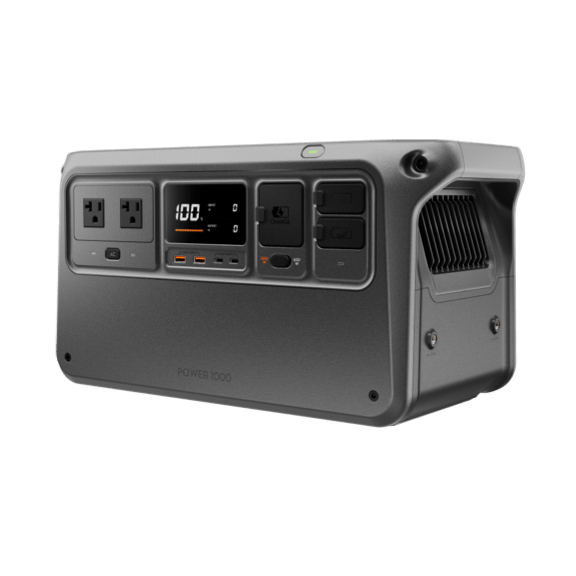
From USD $299
From USD $699
 USB-C Port Max Output Power
 USB-C Port Max Output Power
 Grid Power
Car Power
Solar Power
USB-C Recharging
 Grid Power
Car Power
Solar Power
Let’s Answer Your Questions
How is the safety performance of DJI Power 1000?
What should I pay attention to if I need to return or exchange an item?
What is the warranty period of DJI Power 1000?
What recharging methods does DJI Power 1000 support?
Do I need to buy solar panels?
In what ways does DJI Power 1000 supply power?
What functions are supported with the SDC port?
What is the noise level when recharging the DJI Power 1000?
Still have questions? Get help from a DJI expert.
1. At a room temperature of 25° C (77° F), Power 1000 can stably provide a max continuous output of 2200 W until the battery runs out. Data measured in a DJI laboratory.
2. Measured with the battery temperature at approx. 25° C (77° F) and at approx. 50% battery level. Duration may vary due to differences in battery temperature and battery level. Refer to the actual usage. It is recommended to use max power output when the battery is at a moderate temperature and a relatively higher battery level. Data measured in a DJI laboratory.
3. Fast charge batteries for DJI Mavic 3 series, DJI Air 3/3S, DJI Inspire 3, and the Matrice 30 series. Requires certain accessories, which are sold separately.
4. Tested under laboratory conditions at 25° C (77° F) and should be used for reference only.
5. Measured under 25° C (77° F) laboratory conditions, being recharged in the 600W Standard Recharge Mode, and at an output power of 1000 W.
6. Based on the correct usage of the product, DJI Power 1000 will have an approximate lifespan of 10 years, calculated on the basis of completing one full recharge/discharge cycle on a daily basis. This data is for reference only. Actual user experience may vary.
7. Each USB-C port supports a max output power of 140 W. The device being charged must support the PD 3.1 protocol and use a USB cable that meets EPR specifications.
8. Solar panels, the DJI Power Solar Panel Adapter Module (MPPT), and the adapter cable required for solar recharging are all sold separately.
9. DJI Power 1000 can connect to up to two DJI Power Solar Panel Adapter Modules (MPPT), which can then connect up to three solar panels, meaning up to six solar panels can be connected to DJI Power 1000 at the same time. DJI Power 1000 can also connect to one solar panel through the DJI Power Car Power Outlet to SDC Power Cable.
10. DJI Power Solar Panel Adapter Module (MPPT) and solar panels are sold separately. The minimum time to fully recharge was measured under 25° C (77° F) laboratory conditions and is for reference only. Actual recharging time is subject to factors like the angle of sunlight and light intensity. Actual user experience may vary. Solar panels from DJI-certified brand Zignes are recommended. To use solar panels not officially recommended by DJI, convert the solar panel connector to an XT60 interface. To prevent damage to the MPPT module and the power station, ensure the open-circuit voltage of each solar panel is less than 30 V. The power output of each solar panel connected to a single XT60 interface should not exceed 200 W, with the total output power of solar panels connected to the entire MPPT module capped at 400 W.