


DJI Power 1000 & 100W Solar Panel × 1
Select Option
Take a Closer Look


In the Box

DJI Power 1000
× 1

DJI Power AC Power Cable
× 1

Zignes 100W Solar Panel
× 1

DJI Power Car Power Outlet to SDC Power Cable (12V/24V)
× 1


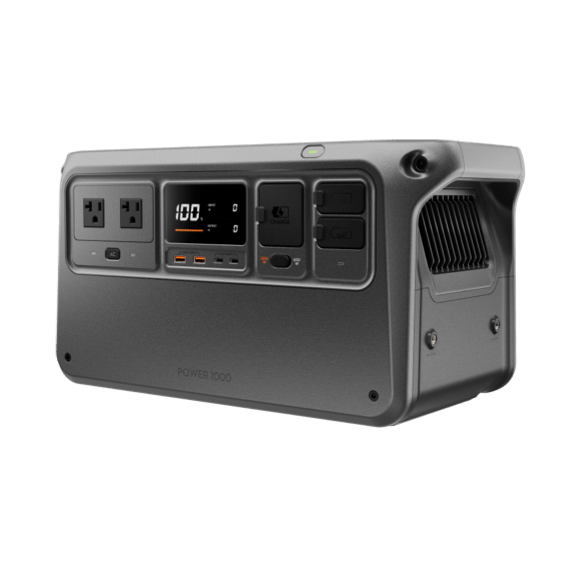
Large 1024Wh Power Supply for Charging Multiple Devices
Which is the Best for You?

From USD $379
From USD $699
 USB-C Port Max Output Power
 USB-C Port Max Output Power
 Grid Power
Car Power
Solar Power
USB-C Recharging
 Grid Power
Car Power
Solar Power
Let’s Answer Your Questions
How is the safety performance of DJI Power 1000?
From the body structure and cell chemistry to the system software, DJI Power 1000 features a comprehensive safety design. It has passed 26 product test certifications from the Swiss third-party testing authority SGS, ensuring worry-free electrical usage.
In terms of hardware, the automotive-grade LFP cell is safe and durable, and can achieve up to 4000 cycles, providing a lifespan of approximately 10 years, even with frequent use.
For structure, DJI Power 1000 uses flame-retardant material and supports weights of up to 100 kg (220 lbs), further enhancing safety and reliability.
In terms of software, DJI Power 1000 adopts the intelligent Battery Management System (BMS). When the safety threshold of electricity usage is surpassed, the protective mechanism for supplying power and recharging will kick into action automatically. Once the electricity supply returns to normal, DJI Power 1000 will resume operation. This prevents situations like over-current, over-voltage, and over-discharge.
What should I pay attention to if I need to return or exchange an item?
Starting from the date of receipt, DJI Power 1000 offers 30-day returns and exchange services. Due to logistic regulations, use the product’s original packaging when shipping the power station. To ensure your shopping experience, it is recommended to retain the original packaging during the product's refund period.
What is the warranty period of DJI Power 1000?
DJI Power 1000 comes with a 3-year official warranty, and users can enjoy an additional 2-year warranty extension by registering related information on the DJI official website.
What recharging methods does DJI Power 1000 support?
There are three recharging methods:
1. Recharging with AC power through the AC input port.
2. Recharging with solar power via the DJI Power Solar Panel Adapter Module (MPPT) and solar panels.
3. Recharging with a car power outlet via the DJI Power Car Power Outlet to SDC Power Cable (12V/24V).
The fastest recharging method is through the AC input port. It takes just 70 minutes to charge from 0% to 100%, and approximately 50 minutes to charge from 0% to 80%.
Do I need to buy solar panels?
DJI Power 1000 can be connected to solar panels through the DJI Power Solar Panel Adapter Module (MPPT) for eco-friendly solar power recharging. MPPT (Maximum Power Point Tracking) is an intelligent algorithm that supports real-time monitoring of the voltage generated by connected solar panels. By tracking and maintaining the highest voltage and current values (V-I), the algorithm allows the solar panels to recharge DJI Power 1000 in an optimized and efficient way.
DJI Power 1000 can connect up to two DJI Power Solar Panel Adapter Modules (MPPT), and each can then connect to one to three solar panels. This means up to six solar panels can be used at the same time at a max solar power input of 800 W, which can fully recharge the power station in 1.35 hours[9] at the soonest. In scenarios like camping or home backup battery where you need a long-lasting power source, we strongly recommend purchasing solar panels. It helps extend the operating time of DJI Power 1000.
In what ways does DJI Power 1000 supply power?
There are three ways to supply power: From the AC output ports, the USB ports, and the SDC or SDC Lite port.
The AC output ports can be directly connected to common household appliances.
USB ports can power laptops, mobile phones, or other digital devices.
The SDC port and SDC Lite port support a variety of power supply extensions through accessories, and can fast charge select DJI drone batteries, such as those from the Mavic 3 series and Air 3/3S.
What functions are supported with the SDC port?
1. Recharging the power station with solar power via the DJI Power Solar Panel Adapter Module (MPPT).
2. Fast charging DJI Mavic 3 Series Intelligent Flight Battery, DJI Air 3/3S Intelligent Flight Battery, Matrice 30 Series TB30 Intelligent Flight Battery, and DJI Inspire 3 TB51 Intelligent Battery using the corresponding fast charge cable.
3. Supplying power to car-powered appliances via the DJI Power SDC to Car Charger Plug Power Cable.
4. Charging model aircraft batteries outdoors by connecting to the balance charger (model aircraft battery balance charger) via the DJI Power SDC to XT60 Power Cable (12V).
5. Recharging the power station with a car’s power outlet via the DJI Power Car Power Outlet to SDC Power Cable (12V/24V).
What is the noise level when recharging the DJI Power 1000?
At an indoor temperature of 25° C (77° F), while keeping a 100cm distance from DJI Power 1000, the noise is approximately 23 dB when using the 600W Standard Recharge Mode.
Still have questions? Get help from a DJI expert.
1. At a room temperature of 25° C (77° F), Power 1000 can stably provide a max continuous output of 2200 W until the battery runs out. Data measured in a DJI laboratory.
2. Measured with the battery temperature at approx. 25° C (77° F) and at approx. 50% battery level. Duration may vary due to differences in battery temperature and battery level. Refer to the actual usage. It is recommended to use max power output when the battery is at a moderate temperature and a relatively higher battery level. Data measured in a DJI laboratory.
3. Measured 100 cm away from DJI Power 1000 while it was being recharged in the Standard Recharging Mode, and is for reference only.
4. Requires certain accessories, which are sold separately.
5. Each USB-C port supports a max output power of 140 W. The device being charged must support the PD 3.1 protocol and use a USB cable that meets EPR specifications.
6. Data tested under laboratory conditions at 25° C (77° F) and should be used for reference only.
7. Requires the DJI Power Solar Panel Adapter Module (MPPT) and solar panels. The aforementioned accessories are sold separately. The minimum time to fully recharge was measured under 25° C (77° F) laboratory conditions and is for reference only. Actual recharging time is subject to factors like the angle of sunlight and light intensity. Actual user experience may vary. Solar panels from DJI-certified brand Zignes are recommended. To use solar panels not officially recommended by DJI, convert the solar panel connector to an XT60 interface. To prevent damage to the MPPT module and the power station, ensure the open-circuit voltage of each solar panel is less than 30 V. The power output of each solar panel connected to a single XT60 interface should not exceed 200 W, with the total output power of solar panels connected to the entire MPPT module capped at 400 W.
8. Measured under 25° C (77° F) laboratory conditions, being recharged in the 600W Standard Recharge Mode, and at an output power of 1000 W.
9. Based on the correct usage of the product, DJI Power 1000 will have an approximate lifespan of 10 years, calculated on the basis of completing one full recharge/discharge cycle on a daily basis. This data is for reference only. Actual user experience may vary.
10. Charging times measured from 10% to 95% battery for the DJI Mavic 3 Series Intelligent Flight Batteries using DJI Power 1000 (with the corresponding fast charge cable) versus other power station (with a 65W charger).
11. In laboratory conditions of 25° C (77° F), when DJI Power 1000 needs to be recharged after being fully discharged from use at rated power, the wait time for the unit to reach a low enough temperature to begin recharging is reduced by as much as 1 hour compared to traditional power stations.
12. Data measured in a DJI laboratory.